The global smart polymers market was valued at USD 12.84 billion in 2023 and is projected to reach USD 17.76 billion by 2030, growing at a CAGR of 4.5% from 2024 to 2030. Smart polymers are specially designed to react to specific biological signals, enabling the development of customized drug delivery systems and personalized medical devices.
The rise of personalized medicine is one of the key drivers of growth in the smart polymers market, facilitating the creation of advanced smart polymers with specialized functionalities. As personalized medicine becomes more prominent, the demand for smart polymers that can be tailored to the specific needs of individual patients continues to grow.
Additionally, smart polymers are increasingly being used in industries such as consumer goods and electronics due to their unique properties. In the electronics sector, smart polymers are employed in the creation of flexible electronic devices and sensors. In the consumer goods sector, these polymers are incorporated into products like adaptive clothing and self-cleaning surfaces. The demand for high-performance materials across these industries is helping to fuel the growth of the smart polymers market.
Collaborations between key industry players, academic institutions, and research organizations are also playing a crucial role in advancing the development and commercialization of smart polymers. These strategic partnerships facilitate the exchange of knowledge, provide access to cutting-edge technologies, and offer shared resources, all of which accelerate market growth. A prime example of this collaboration is Adidas' partnership with Rheon in March 2023, which led to the creation of the Techfit Control apparel range. This collaboration combines Adidas’ material innovations with Rheon’s intelligent polymer technology, delivering enhanced support during training and high-energy movements. The polymer in this clothing reacts to the body's movements, offering responsive support.
Order a free sample PDF of the Smart Polymers Market Intelligence Study, published by Grand View Research.
Key Market Trends & Insights
- Asia Pacific dominated the smart polymers market in 2023, capturing 38.1% of the revenue share. The region’s growing consumer demand for advanced and interactive products, including responsive textiles, flexible electronics, and self-healing materials, is driving the adoption of smart polymers. The increasing preference for high-performance products in sectors like electronics, fashion, and healthcare further contributes to the region’s strong market growth.
- Type of Polymer: The physical stimuli-responsive polymers segment led the market in 2023, accounting for 39.7% of the revenue share. The demand for smart textiles that incorporate physical stimuli-responsive polymers is propelling this segment’s growth. These polymers respond to external factors such as temperature or mechanical stress, offering functionalities like self-healing, shape memory, and adaptive insulation. The rise in demand for high-performance, interactive clothing, coupled with advancements in textile technology, is boosting the adoption of these polymers in the fashion and sportswear industries.
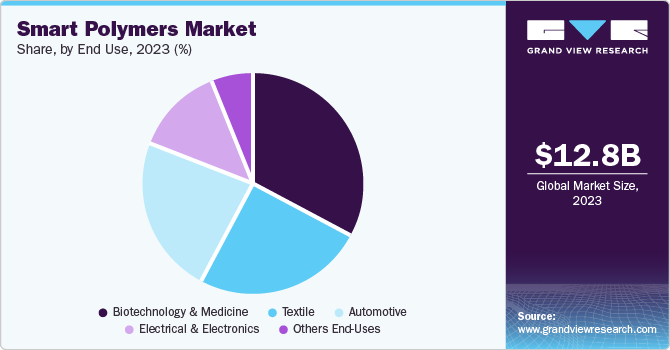
- End-Use Sector: The biotechnology & medicine segment was the largest revenue-generating sector in 2023. Smart polymers are increasingly used in medical devices and implants because of their ability to respond dynamically to physiological changes. They are incorporated into applications such as drug-eluting stents, dynamic orthopedic implants, and responsive contact lenses. The growing demand for advanced medical devices that enhance patient outcomes and functionality is driving the expansion of smart polymers in this sector.
Market Size & Forecast
- 2023 Market Size: USD 12.84 Billion
- 2030 Projected Market Size: USD 17.76 Billion
- CAGR (2024-2030): 4.5%
- Asia Pacific: Largest market in 2023
Key Companies & Market Share Insights
Several key players are driving the growth of the smart polymers market, including:
- The Lubrizol Corporation: A subsidiary of Berkshire Hathaway, Lubrizol is a global leader in specialty chemicals, including the production of smart polymers and other advanced materials for a variety of industries such as transportation, industrial, and consumer goods markets.
- BASF SE: Operating across numerous industries, BASF offers a wide array of innovative products, including smart polymers. Their extensive portfolio spans areas such as chemicals, performance products, functional materials, and agricultural solutions.
Other notable players include Covestro AG, Huntsman International LLC, and several emerging companies driving innovation in the smart polymers space.
Key Players
- The Lubrizol Corporation
- BASF SE
- Covestro AG
- Huntsman International LLC.
- DuPont
- Evonik Industries AG
- SMP Technologies Inc.
- Merck KGaA
- Akina, Inc.
- Autonomic Materials
- NIPPON SHOKUBAI CO., LTD.
Explore Horizon Databook – The world's most expansive market intelligence platform developed by Grand View Research.
Conclusion
The global smart polymers market is set for steady growth between 2024 and 2030, fueled by advancements in personalized medicine, the increasing demand for high-performance materials, and their expanding applications in industries such as electronics, fashion, and biotechnology. The growth of Asia Pacific as the leading market, combined with the dominance of physical stimuli-responsive polymers, highlights the growing interest in smart materials with adaptive and interactive properties. Furthermore, strategic collaborations between industry leaders and academic institutions are accelerating innovation and driving market expansion. As the demand for tailored solutions continues to rise, smart polymers are likely to play an increasingly critical role in shaping industries that require high-performance, responsive materials.

No comments:
Post a Comment