The global mirror coatings market was valued at USD 819.57 million in 2024 and is expected to reach USD 1,309.05 million by 2033, expanding at a CAGR of 5.4% from 2025 to 2033. This growth is largely fueled by rising demand across the construction, automotive, and solar energy sectors.
Increased applications in decorative interiors, architectural glass, and smart mirrors are contributing to the market’s expansion. Ongoing technological advancements—particularly in nano coatings and eco-friendly formulations—have significantly improved mirror durability, reflectivity, and UV protection, drawing the attention of environmentally conscious consumers.
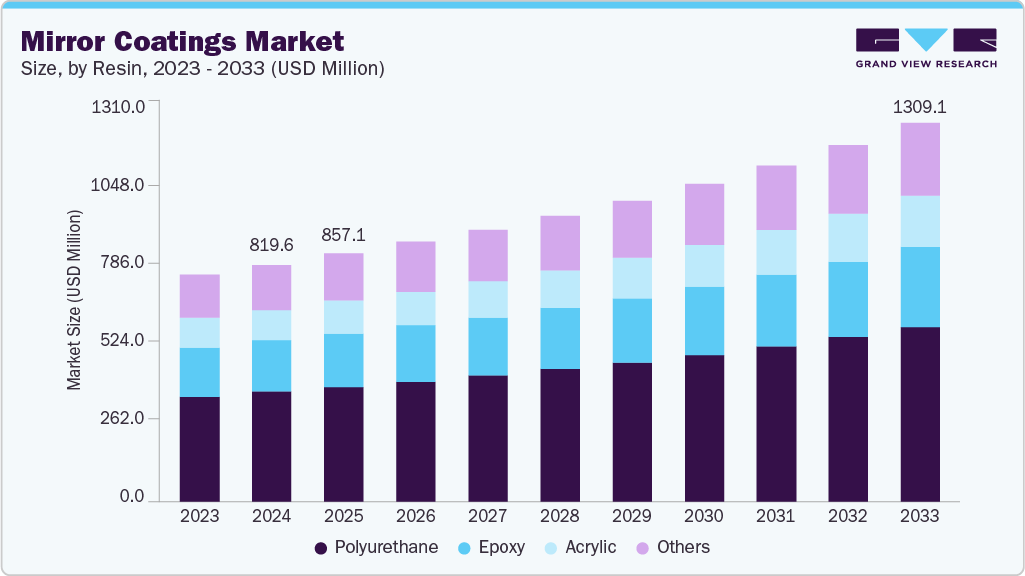
Market growth is underpinned by a combination of rapid urbanization, infrastructure investment, and evolving construction technologies. The increasing development of premium residential and commercial buildings has led to greater demand for high-performance architectural and decorative mirrors. In the automotive sector, mirror coatings enhance safety, aesthetics, and visibility, especially in electric and luxury vehicles. Additionally, the growing use of concentrated solar power (CSP) systems in emerging markets has increased the need for high-efficiency reflective coatings that improve energy yield.
Technological innovations, especially in nanocoatings, provide added value with features such as anti-fog, scratch resistance, and UV protection, aligning with sustainable product trends.
Despite these drivers, the industry faces challenges including high raw material costs and complex manufacturing processes. Fluctuating prices of components such as silver, aluminum, and titanium dioxide raise production costs. Stringent regulations, particularly in Europe and North America, limit formulation flexibility and increase compliance expenditures. Additionally, applying advanced coatings requires specialized equipment and trained personnel, which raises costs for end users. In developing regions, limited awareness and access to high-performance coatings can further restrict market penetration.
Order a free sample PDF of the Mirror Coatings Market Intelligence Study, published by Grand View Research.
Key Market Trends & Insights
- Asia Pacific dominated the global market in 2024, accounting for a 38.6% revenue share. Growth is attributed to urban expansion, increasing construction activity, and growing automotive production across countries like China, India, and Southeast Asia. Investments in solar infrastructure and green building initiatives are driving demand for eco-friendly mirror coatings.
- By resin type, the polyurethane segment led the market with a 46.4% share in 2024, owing to its superior abrasion resistance, flexibility, and gloss, ideal for architectural and automotive applications. Epoxy coatings are also valued for strong adhesion and chemical resistance in industrial settings.
- By technology, water-based coatings held the largest market share at 40.5% in 2024, driven by strict VOC regulations in North America and Europe. These coatings provide lower emissions and now offer performance comparable to solvent-based systems, thanks to recent formulation improvements.
- By end-use, the architectural sector dominated in 2024, contributing to 58.8% of global revenue. Increased adoption of high-performance coated mirrors in modern architecture—such as windows, elevators, and bathrooms—is propelled by interior design trends, urbanization, and the demand for natural lighting. Advanced coatings with UV protection, anti-fog, and scratch resistance have improved product lifespan in high-traffic applications.
Market Size & Forecast
- 2024 Market Size: USD 819.57 Million
- 2033 Projected Market Size: USD 1,309.05 Million
- CAGR (2025-2033): 5.4%
- Asia Pacific: Largest market in 2024
- Europe: Fastest growing market
Key Companies & Market Share Insights
- Edmund Optics Inc. (USA): Specializes in precision optical components and coatings, serving industries such as life sciences, defense, and semiconductors, with a global manufacturing presence and strong focus on innovation.
- Diamon-Fusion International, Inc. (DFI) (USA): Offers CVD-based hydrophobic and protective coatings. Known for Diamon-Fusion®, which improves durability, scratch resistance, and water repellency in mirrors. Operates in over 30 countries and emphasizes sustainability.
- General Optics (Asia) Limited (India): A subsidiary of Optics Balzers AG, focused on thin-film optical coatings for sectors like medical, defense, and industrial. With strong R&D capabilities and ISO-certified facilities, it serves the growing demand in Asia Pacific.
Other notable players include Arkema, SHERWIN-WILLIAMS, Pearl Nano, North America Coating Laboratories, Dynasil Corporation, and Guardian Industries.
Key Players
- Abrisa Technologies
- AccuCoat inc.
- Arkema
- CASIX, Inc
- Diamon-Fusion International, Inc.
- Dynasil Corporation
- Edmund Optics Inc.
- FENZI S.p.A.
- General Optics (Asia) Limited
- Guardian Industries
- JENOPTIK AG
- North America Coating Laboratories
- Pearl Nano
- SHERWIN-WILLIAMS
Explore Horizon Databook – The world's most expansive market intelligence platform developed by Grand View Research.
Conclusion
The global mirror coatings market is set for steady growth over the next decade, driven by rising demand from the construction, automotive, and renewable energy sectors. Technological innovations in nano and eco-friendly coatings, alongside increased adoption of smart and sustainable materials, are shaping the future of the industry. While high material costs and regulatory complexities may pose short-term challenges, expanding opportunities in emerging markets, the rise of smart coatings, and strategic industry collaborations are expected to fuel market expansion through 2033. The Asia Pacific region remains the dominant force, while Europe is poised to grow rapidly amid stricter environmental mandates and sustainability trends.

No comments:
Post a Comment