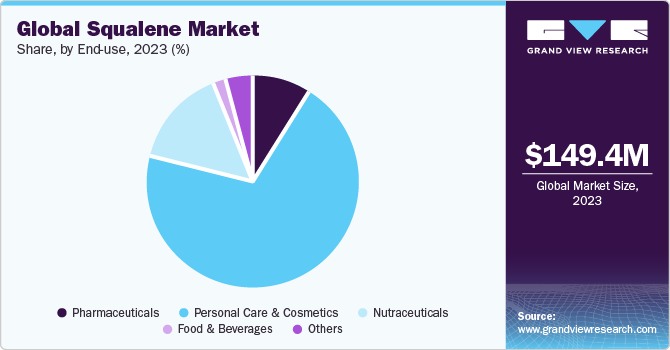
The global squalene market was valued at USD 149.4 million in 2023 and is expected to reach USD 307.9 million by 2030, expanding at a CAGR of 10.9% from 2024 to 2030. The rising preference for natural ingredients in the personal care and cosmetics industry is one of the primary factors driving market growth.
Squalene is a translucent, low-odor compound recognized for its strong moisturizing properties, making it one of the most widely used emollients globally. Its non-toxic nature contributes significantly to its popularity in personal care applications. In the cosmetics sector, squalene oil is valued for its ability to neutralize free radicals that can damage skin cells and accelerate aging.
The ingredient is featured in a broad range of cosmetic and personal care products, including lotions, hair conditioners, bath oils, lipsticks, creams, and foundations. Increasing consumer demand for natural and organic formulations is further strengthening market demand. Additionally, the use of squalene in vaccines is contributing to market expansion. Squalene is an essential component in several vaccines—including COVID-19 vaccines—due to its strong adjuvant properties that help enhance immune response.
Squalene used in pharmaceutical and vaccine applications is typically derived from purified fish oil extracted from sharks. However, a report from the International Trade of Endangered Species indicates that five shark species are currently threatened with extinction. This scenario is expected to reduce the reliance on animal-based sources and accelerate the shift toward plant-based and synthetic alternatives.
Order a free sample PDF of the Squalene Market Intelligence Study, published by Grand View Research.
Key Market Trends & Insights
- Europe led the market in 2023 with a 32.8% revenue share, followed by Asia Pacific. This dominance is linked to the region’s large-scale olive oil production—a major plant-based source of squalene—and strong demand from major economies such as Germany, France, the UK, Italy, and Spain.
- Plant-based sources accounted for over 82.3% of revenue in 2023. This shift is driven by declining shark populations, rising consumer awareness of animal welfare, and government regulations aimed at protecting marine species.
- The personal care and cosmetics segment held over 70.1% of the market in 2023. Its leadership is attributed to the extensive use of squalene in skincare and haircare formulations.
Market Size & Forecast
- 2023 Market Size: USD 149.4 Million
- 2030 Projected Market Size: USD 307.9 Million
- CAGR (2024-2030): 10.9%
- Europe: Largest market in 2023
Key Companies & Market Share Insights
The squalene market is fragmented and highly competitive, with major players concentrated in Europe and North America, while numerous smaller manufacturers are based in the Asia Pacific region—particularly in India, China, and Japan—where access to shark liver oil and olive oil is abundant.
Leading companies frequently form partnerships to expand their product reach and leverage broader distribution networks. For example, in May 2023, Amyris announced a partnership with Croda International Plc. to supply pharmaceutical-grade squalene for use in vaccine adjuvants designed to improve immune response.
Key Players
- Amyris, Inc.
- Sophim SAS
- Henry Lamotte Oils GmbH
- efpbiotek
- Vestan Limited
- Kuraray Co., Ltd.
- Croda International Plc
- AASHA BIOCHEM
- Arbee
- Oleicfat, s.l.
- Kishimoto Special Liver Oil Co., Ltd.
Explore Horizon Databook – The world's most expansive market intelligence platform developed by Grand View Research.
Conclusion
The global squalene market is poised for steady growth, supported by increasing demand for natural and organic ingredients in cosmetics and personal care products. Its role as a moisturizing and anti-aging ingredient continues to anchor its importance in premium formulations. The expanding use of squalene in vaccines further strengthens market prospects, particularly as global health initiatives emphasize effective immunization technologies. As environmental concerns and regulatory measures limit shark-derived squalene, plant-based and synthetic alternatives are expected to gain momentum. With Europe leading the market and strong growth anticipated across Asia Pacific, the industry is set for continued expansion through 2030.

No comments:
Post a Comment