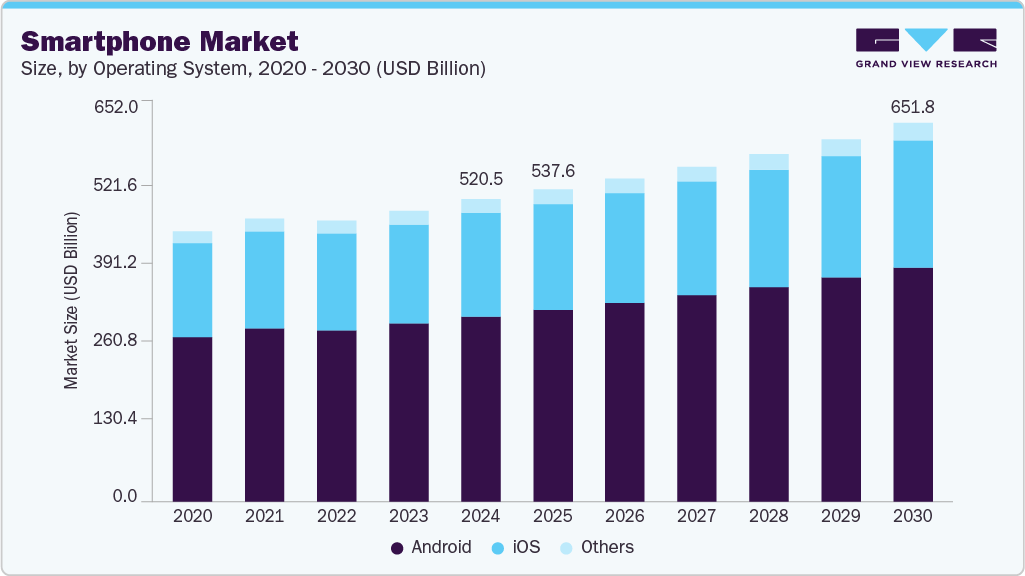
The global smartphone market was valued at USD 520.45 billion in 2024 and is projected to reach USD 651.82 billion by 2030, reflecting a CAGR of 3.9% from 2025 to 2030. Market growth is supported by rising demand for feature-packed yet cost-effective devices, rapid advancements in 5G networks, and increasing digital dependence across both emerging and developed regions.
Key factors driving the industry include the widespread adoption of AI-powered features—such as on-device generative AI, enhanced computational photography, and real-time language translation—along with broader integration into IoT ecosystems. Smartphone sales are further fueled by the expansion of e-commerce platforms, competitive pricing models, and shorter replacement cycles brought on by fast-paced technological upgrades. Sustainability efforts, including modular repairability, recycled material usage, and energy-efficient processors, are also becoming vital elements of brand differentiation. Meanwhile, growing demand from industries such as gaming, fintech, and enterprise mobility continues to influence device capabilities and performance standards.
Increasing smartphone penetration in both advanced and developing economies also contributes to long-term market growth. Smartphones have evolved into essential tools for communication, entertainment, and productivity, ensuring consistent consumer demand. The rising popularity of wearable devices, including smartwatches and fitness trackers, has also fueled market expansion as health and wellness awareness grows. Their integration with broader smart home ecosystems—such as voice assistants and security technologies—further enhances user engagement. For example, in January 2025, Alarm.com introduced its AI Deterrence (AID) service, an automated audio response system that strengthens property security by issuing AI-generated verbal warnings tailored to intruders’ visual cues, such as clothing characteristics and environmental context.
Order a free sample PDF of the Smartphone Market Intelligence Study, published by Grand View Research.
Key Market Trends & Insights
- Regional Insights: Asia Pacific held the largest revenue share of 47.7% in 2024, driven by a young population, expanding internet access, and strong competition among local manufacturers. Regional OEMs continue to innovate with aggressive pricing, advanced features, and localized applications. The rapid adoption of mobile-first financial services, super apps, and digital entertainment platforms fuels sustained smartphone demand, particularly in India and Southeast Asia.
- By Operating System: Android led the global market with a 61.4% revenue share in 2024. Its continued growth is supported by strong alignment with trends in content creation, performance optimization, and extended software support. Manufacturers are increasingly embedding system-level AI capabilities—such as intelligent imaging, contextual search, and productivity tools—particularly in mid-premium devices.
- By Distribution Channel: Offline retail dominated the industry in 2024, maintaining the largest market share as consumers increasingly prioritize in-person product evaluation. With rising demand for premium smartphones, shoppers seek hands-on validation of camera quality, build materials, display characteristics, and overall performance before making purchase decisions.
- By Price Range: The mid-range category, which held the largest share in 2024, is expected to grow at the fastest CAGR from 2025 to 2030. This segment remains strong as consumers look for devices that deliver a balanced mix of performance, battery efficiency, camera quality, and design at accessible price points. Growth is largely driven by users upgrading from entry-level devices and those seeking near-premium features—such as AMOLED displays, fast charging, AI-supported multi-lens cameras, and 5G connectivity—without reaching flagship-level pricing.
Market Size & Forecast
- 2024 Market Size: USD 520.45 Billion
- 2030 Projected Market Size: USD 651.82 Billion
- CAGR (2025-2030): 3.9%
- Asia Pacific: Largest market in 2024
Key Companies & Market Share Insights
Leading companies in the smartphone market include Apple Inc., Samsung Electronics Co. Ltd., Xiaomi Corporation, Google LLC, and OnePlus. These players continue to pursue strategies such as product innovation, strategic partnerships, and long-term collaborations to maintain competitive advantages.
Examples of recent initiatives include:
- Apple Inc. launched AppleCare+ One in July 2025, offering a unified subscription covering iPhone, Mac, iPad, and Apple Watch. This bundled service simplifies device protection, adds theft and loss coverage, and provides priority support.
- Google LLC acquired part of HTC’s extended reality (XR) unit in January 2025 for about USD 250 million, gaining access to specific VIVE engineering personnel and related non-exclusive IP rights. This acquisition supports the development of Google’s Android XR platform and strengthens its partnerships across the XR ecosystem.
- Xiaomi Corporation entered into partnerships with Dixon, DBG, and additional EMS companies in July 2024 to expand smartphone and device assembly in India. The initiative aims to achieve 55% local component sourcing and double device shipments to 700 million in India over the next decade.
Key Players
- Apple Inc.
- Asus
- Google LLC
- Huawei
- HMD Global
- Lenovo Group Limited
- Motorola
- OnePlus
- Oppo
- Realme
- Samsung Electronics Co. Ltd.
- Sony Corporation
- Vivo
- Xiaomi Corporation
- ZTE Corporation
Explore Horizon Databook – The world's most expansive market intelligence platform developed by Grand View Research.
Conclusion
The global smartphone market continues to evolve, driven by steady adoption of advanced technologies, rising digital engagement, and increasing consumer expectations across all price segments. While overall growth remains moderate, sustained innovation in AI, 5G connectivity, sustainability features, and ecosystem integration keeps the market dynamic and competitive. Asia Pacific remains the leading region, powered by strong consumer demand and rapid digital transformation. With major players such as Apple, Samsung, Xiaomi, and Google actively investing in AI capabilities, local manufacturing, and ecosystem expansion, the smartphone industry is set to maintain long-term relevance and stable growth through 2030.

No comments:
Post a Comment