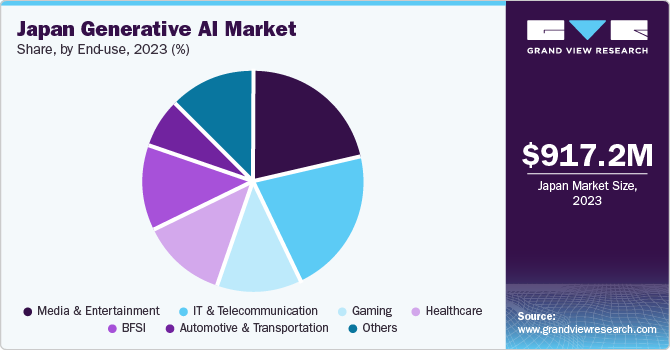
The Japan generative AI market was valued at USD 917.2 million in 2023 and is projected to expand to USD 8.09 billion by 2030, reflecting a robust Compound Annual Growth Rate (CAGR) of 37.5% from 2024 to 2030. Generative AI refers to algorithms that create new content, including text, images, code, audio, videos, and simulations. The growth of generative AI in Japan is largely driven by its ability to automate time-consuming and repetitive tasks, enabling employees to focus on more creative and complex activities. By analyzing unstructured data, streamlining decision-making, and optimizing workflows, this technology enhances productivity and reduces the risk of errors.
Japan's aging population and ongoing labor shortages have sparked a heightened interest in automation and AI solutions. Generative AI presents an opportunity to address workforce challenges by automating repetitive tasks and improving overall productivity. Japanese companies are increasingly turning to generative AI to streamline operations, enhance efficiency, and create innovative products and services, especially in sectors like manufacturing, healthcare, and customer service. Japan's demographic trends are significant, with 29.1% of its population aged 65 or older in 2022, as reported by Nippon. Additionally, only 35% of Japanese companies prioritize workers over the age of 55, as highlighted by the World Economic Forum’s Future of Jobs Report 2023. These factors are further fueling the adoption of generative AI in the country.
Government initiatives have also played a key role in promoting the growth of generative AI. Japan's government has made AI research and development a national priority, aiming to drive economic growth and maintain technological leadership. Through funding programs, strategic partnerships with industry and academia, and regulatory frameworks, Japan seeks to harness the potential of generative AI to solve societal challenges and enhance global competitiveness. For example, in February 2023, the Japanese Ministry of Industry allocated more than USD 56 million to fund AI initiatives at seven organizations, including universities and start-ups across the nation.
Order a free sample PDF of the Japan Generative AI Market Intelligence Study, published by Grand View Research.
Key Market Trends & Insights
- Software Segment Dominance: In 2023, the software segment accounted for the largest revenue share of 65.0%. The increasing awareness of the vast applications and benefits of generative AI software is driving its rapid growth in both business and consumer markets. This trend is expected to continue throughout the forecast period.
- Transformers Technology Leadership: The transformers segment held the largest revenue share in 2023. Transformers' scalability and efficiency have made them a cornerstone in generative AI applications, as they can process large datasets and scale effectively to handle increasingly complex tasks and larger models.
- Media & Entertainment Segment Growth: The media and entertainment sector was the leading end-use segment in 2023 and is expected to grow at a significant CAGR during the forecast period. The rise of digital platforms and streaming services has created a demand for scalable, cost-effective content production solutions, boosting the adoption of generative AI.
- Natural Language Processing (NLP) Application: The NLP segment dominated the market in 2023 and is projected to maintain strong growth in the coming years. Generative AI is widely used in NLP applications for content creation, storytelling, and creative writing, enabling the generation of creative and personalized content.
- Large Language Model Dominance: The large language model segment held the largest share of the market in 2023 and is expected to grow significantly during the forecast period. The growth is driven by the increasing availability of computational resources, including powerful GPUs, TPUs, and cloud infrastructure, which enable the training and deployment of large language models.
Market Size & Forecast
- 2023 Market Size: USD 917.2 Million
- 2030 Projected Market Size: USD 8.09 Billion
- CAGR (2024-2030): 37.5%
Key Companies & Market Share Insights
Some of the prominent companies operating in the Japan generative AI market include Preferred Networks, Abeja, and Cinnamon, among others. These companies are adopting strategies such as developing user-specific products, innovating in packaging and algorithms, and establishing strong distribution networks to cater to growing demand.
- Preferred Networks is a leading technology company specializing in robotics, deep learning, and AI applications across sectors like transportation, materials discovery, manufacturing, education, and life sciences. The company provides advanced software frameworks and hardware to support research and development across these industries.
- Abeja offers AI-based business solutions, including the ABEJA Platform, which specializes in image analysis, in-store marketing, and display optimization. The platform helps drive digital transformation by streamlining data collection, processing, and analysis.
- LeapMind provides AI-based cognitive technology aimed at making deep learning more accessible. The company’s solutions support various applications in industries such as robotics, education, and manufacturing.
- Studio Ousia focuses on developing multilingual natural language processing (NLP) software, offering AI-driven solutions that help businesses handle large volumes of text data.
Key Players
- Preferred Networks
- Abeja
- Cinnamon
- Ubie
- Ascent Robotics
- LeapMind
- Stockmark
- Studio Ousia
- Heroz
- Autify
Explore Horizon Databook – The world's most expansive market intelligence platform developed by Grand View Research.
Conclusion
The Japan generative AI market is poised for substantial growth, with a projected market size increase of over USD 7 billion by 2030. This growth is driven by Japan’s aging population, labor shortages, and the increasing adoption of generative AI to automate repetitive tasks and improve productivity across various sectors. Generative AI’s ability to streamline workflows and optimize decision-making processes is attracting widespread attention, particularly in media, entertainment, and healthcare. The government’s active support for AI research and development is also contributing to this growth, making generative AI a central component of Japan’s future economic and technological strategy. As a result, Japan’s generative AI market will continue to expand rapidly, with companies innovating in software, NLP, and large language models to meet the rising demand for AI-driven solutions.

No comments:
Post a Comment