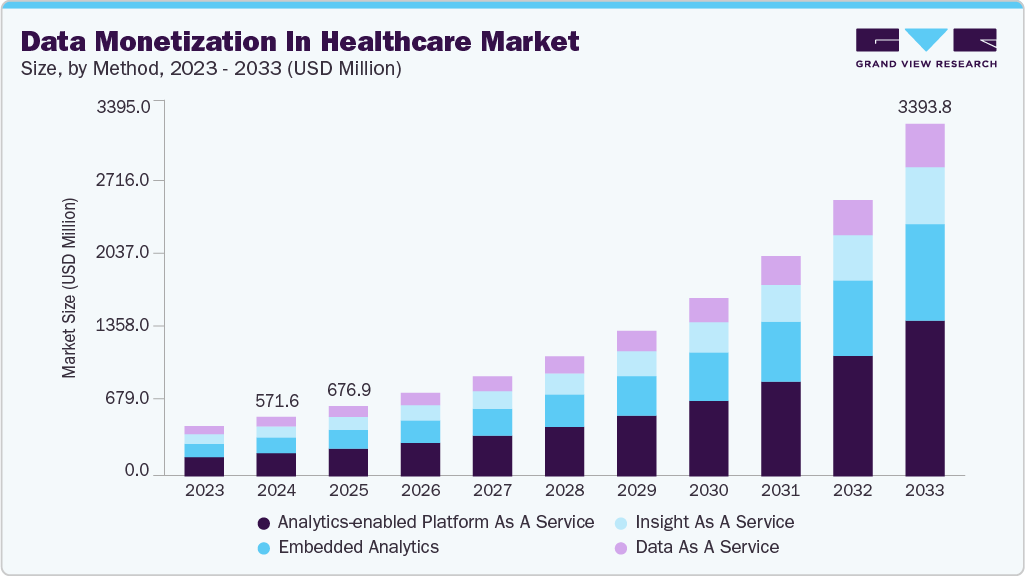
The global data monetization in healthcare market was valued at USD 571.6 million in 2024 and is projected to reach USD 3,393.8 million by 2033, growing at a CAGR of 22.3% from 2025 to 2033. This rapid growth is primarily driven by the widespread adoption of electronic health records (EHRs) and increasing public and private investments in advanced analytics solutions.
Healthcare organizations are increasingly recognizing the value of robust data management strategies and the potential to monetize data assets. The integration of emerging technologies such as Blockchain, Machine Learning (ML), Artificial Intelligence (AI), cloud computing, and big data analytics is accelerating this trend. These technologies enable healthcare, pharmaceutical, and medtech companies to extract actionable insights from data—enhancing business growth, improving operational efficiency, predicting risks, and detecting anomalies.
Market Evolution and Technological Advancements
The healthcare data monetization landscape is evolving rapidly due to the convergence of intelligent automation and advanced analytics platforms. These technologies enable organizations to manage and monetize vast datasets with improved precision and minimal manual oversight.
A significant trend in this evolution is the emergence of agentic AI and autonomous data ecosystems. These systems empower healthcare providers, payers, and life sciences firms to unlock the latent value within their data while ensuring compliance, security, and contextual intelligence. Integrated platforms support real-time insights, predictive modeling, anomaly detection, and revenue optimization.
For example, in May 2025, Brillio launched ADAM, an agentic AI platform designed to automate the end-to-end healthcare data lifecycle—from acquisition and contextualization to monetization. By leveraging generative AI, cognitive agents, and adaptive orchestration, ADAM enables healthcare organizations to convert fragmented data into actionable, revenue-generating assets. This development reflects a broader shift in the industry, where AI-powered platforms are evolving into core engines of growth, driving efficiency, decision-making, and competitive advantage.
Order a free sample PDF of the Data Monetization in Healthcare Market Intelligence Study, published by Grand View Research.
Key Market Trends & Insights
- North America dominated the global market with a 32.2% share in 2024, driven by advanced healthcare IT infrastructure, supportive regulatory frameworks for data exchange, and major pharmaceutical and biotech firms investing in data commercialization.
- By method, the analytics-enabled platform-as-a-service segment led with a 38.9% revenue share in 2024. Cloud-based platforms that integrate AI, real-time data processing, and advanced analytics allow organizations to extract value from EHRs, claims data, clinical workflows, and patient experience tools.
- In terms of organization size, large enterprises held the largest market share in 2024. These organizations possess the infrastructure, resources, and data maturity necessary to deploy enterprise-scale data monetization platforms with embedded AI, unified data management, and real-time analytics.
- By end use, the pharmaceutical and biotechnology segment captured the largest share at 39.6% in 2024. These companies leverage clinical, genomic, and patient-derived data to accelerate drug discovery, optimize clinical trials, generate real-world evidence, and support personalized medicine initiatives.
Market Size & Forecast
- 2024 Market Size: USD 571.6 Million
- 2033 Projected Market Size: USD 3,393.8 Million
- CAGR (2025-2033): 22.3%
- North America: Largest market in 2024
- Asia Pacific: Fastest growing market
Key Companies & Market Share Insights
Leading players in the healthcare data monetization market include: Optum, Inc., Oracle Corporation and SAS Institute Inc.
These companies are focusing on product innovation, strategic partnerships, and technology integrations to enhance their market presence and capabilities.
Notable Developments:
- In March 2025, Microsoft and Kyndryl introduced Dragon Copilot, a generative AI-powered healthcare assistant. It automates clinical documentation through voice dictation and ambient listening, integrates with workflows, and reduces administrative burdens for clinicians.
- In January 2025, Nvidia announced partnerships with Mayo Clinic, IQVIA, Illumina, and Arc Institute to deploy its DGX Blackwell systems, AI Foundry, and BioNeMo platforms, supporting AI applications in digital pathology, genomics, and clinical trials.
- In July 2024, Humana signed a multi-year agreement with Google Cloud to modernize its infrastructure using generative AI. The initiative focuses on lowering healthcare costs, enhancing member experience, and delivering personalized care, all while maintaining HIPAA-compliant data security.
Key Players
- Arcadia Solutions LLC
- Cerner Corporation
- Clarify Health Solutions, Inc.
- Flatiron Health, Inc.
- Google LLC
- Health Catalyst, Inc.
- IBM Corporation
- IQVIA Inc.
- Microsoft Corporation
- Optum, Inc.
- Oracle Corporation
- Palantir Technologies Inc.
- SAS Institute Inc.
- Snowflake Inc.
- Truveta, Inc.
Explore Horizon Databook – The world's most expansive market intelligence platform developed by Grand View Research.
Conclusion
The global data monetization in healthcare market is poised for substantial growth, fueled by the convergence of data-driven technologies, growing clinical and operational data volumes, and increased emphasis on value-based care. As healthcare organizations strive to unlock the full potential of their data assets, monetization strategies—powered by AI, cloud platforms, and real-time analytics—are becoming essential to operational success and innovation.
The emergence of autonomous data ecosystems and agentic AI platforms reflects a shift toward intelligent automation, where data not only informs decisions but directly drives revenue generation and competitive differentiation. With a projected market value of USD 3.39 billion by 2033, data monetization is evolving from a strategic advantage into a core pillar of digital healthcare transformation.

No comments:
Post a Comment