The global pressure transmitter market was valued at USD 2,401.6 million in 2023 and is expected to reach USD 3,132.1 million by 2030, registering a CAGR of 3.9% from 2024 to 2030. Market growth is primarily driven by the rising need for accurate, reliable, and consistent pressure measurement across a wide range of industrial applications.
Pressure transmitters are extensively used in industries such as oil and gas, chemical and petrochemical, and power generation. Growing demand across upstream, midstream, and downstream oil and gas operations—including wellhead pressure monitoring, pipeline surveillance, and refinery processing—is a major factor supporting market expansion.
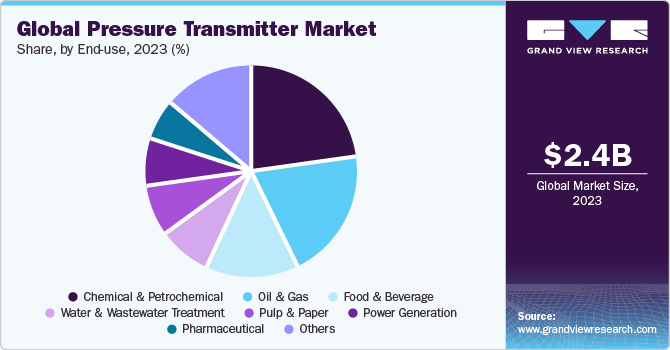
In addition, the increasing adoption of Industry 4.0, along with the shift toward smart factories in the U.S., is contributing to market growth. The introduction of advanced pressure transmitters equipped with features such as wireless communication, digital interfaces, and remote monitoring capabilities is further strengthening demand, particularly in technologically advanced industrial environments.
The need for precise and reliable pressure measurement solutions is also increasing in chemical processing applications. According to the American Chemistry Council, the U.S. chemical industry generated USD 639 billion in revenue in 2022. This industry produces a broad range of products, including plastics, synthetic fibers, fertilizers, pharmaceuticals, and specialty chemicals. High levels of innovation and substantial investments in research and development continue to drive demand for advanced instrumentation, including pressure transmitters. These factors are expected to support sustained market growth over the forecast period.
Order a free sample PDF of the Pressure Transmitter Market Intelligence Study, published by Grand View Research.
Key Market Trends & Insights
- Asia Pacific accounted for the largest revenue share of 46.9% in 2023. Growth in the region is driven by rapid digitalization and the increasing adoption of the industrial Internet of Things (IIoT), which requires advanced sensors capable of real-time data transmission. Rising industrialization, increasing automation, and significant infrastructure investments further support market expansion. Major manufacturing hubs such as China, Japan, and India play a crucial role in driving regional growth.
- By Type, the differential-pressure transmitter segment dominated the market with a revenue share of 51.24% in 2023. These transmitters are widely used for measuring flow, level, and pressure differences across various industrial processes. Their ability to withstand mechanical stress, vibrations, and harsh operating conditions makes them well-suited for industrial environments. Availability in multiple configurations and customization options further enhances their adoption.
- By Sensing Technology, the piezoresistive segment led the market with a revenue share of 46.4% in 2023. Piezoresistive pressure transmitters are valued for their accuracy, durability, and reliability and are widely used in industries such as oil and gas, automotive, aerospace, medical, and chemical processing. Their suitability for harsh environments is expected to drive continued demand.
- By End Use, the oil and gas segment held the largest revenue share of 20.43% in 2023. Pressure transmitters play a critical role in ensuring safe and efficient operations across oil and gas facilities, including offshore platforms and storage tanks. Increasing emphasis on operational safety and process efficiency continues to support market growth in this segment.
- By Fluid Type, the liquid segment dominated the market with a revenue share of 70.71% in 2023. Pressure transmitters are widely used to measure pressure in liquids across industries such as chemicals, pharmaceuticals, food and beverage, water and wastewater treatment, and oil and gas. Their ability to handle corrosive and abrasive fluids in both hazardous and non-hazardous environments drives strong adoption.
- By Application, the pressure measurement segment accounted for the largest revenue share of 49.51% in 2023. These transmitters are designed to deliver high accuracy, fast response times, and reliability. Advanced features such as digital communication protocols, temperature compensation, and self-diagnostics contribute to their widespread use in industrial processes.
Market Size & Forecast
- 2023 Market Size: USD 2,401.6 Million
- 2030 Projected Market Size: USD 3,132.1 Million
- CAGR (2024-2030): 3.9%
- Asia Pacific: Largest market in 2023
Key Companies & Market Share Insights
The global pressure transmitter market is highly competitive, with the presence of both global and regional manufacturers. Companies are focusing on growth strategies such as mergers and acquisitions, joint ventures, and product innovation. Products are distributed through multiple channels, including distributors, company-owned platforms, retailers, and e-commerce. For example, in November 2022, Emerson launched a new line of Rosemount 3051 pressure transmitters designed to deliver enhanced accuracy and reliability in harsh environments, featuring advanced diagnostics and wireless capabilities for easier installation and maintenance.
Key Players
- ABB Group
- Siemens
- Schneider Electric SE
- Hitachi, Company limited
- Honeywell International
- Yokogawa Electric Corp
- Emerson Electric Company
- The Danfoss Group
- Fuji Electric Co ltd v, Ltd.
- TE Connectivity Ltd
- Zemic Group
- Anfield Sensors Inc
- Endress+Hauser AG
- LCM Systems Limited
- SOR Controls Group
Explore Horizon Databook – The world's most expansive market intelligence platform developed by Grand View Research.
Conclusion
The pressure transmitter market is expected to experience steady growth through 2030, supported by increasing industrial automation, rising demand for precise pressure measurement, and the adoption of smart manufacturing technologies. Strong demand from the oil and gas and chemical industries, combined with advancements in sensing technologies and digital connectivity, will continue to shape market development. Asia Pacific is set to remain the dominant region, while ongoing product innovation and strategic expansions by key players will further strengthen the market’s growth trajectory.

No comments:
Post a Comment